Sunday, January 12, 2020

THREE STRONG LATE ENTRIES BRING MOVIES BACK TO HUMANITY

By Dominique Paul Noth

Mark Ruffalo in "Dark Waters"
Three films late in 2019 or early in 2020  seemed to proudly return American film-making to the gripping investigative storytelling that television had pretty much taken over in longer forms than two-hour stories. These are topnotch cinema drawn from real life where dogged Americans are demonstrating again and again how the arc of the universe “slowly bends toward justice.”

Actors and directors expand the best elements of Law and Order and Frontline into important stories that reassure us of the difference dogged persistence can make – and entertain us with potent moments in the bargain.

In order of success as film-making, they are Todd Haynes’ Dark Waters, in which a plodding unexpectedly heroic corporate lawyer for elitist companies, played with pudgy stubbornness by Mark Ruffalo, took on DuPont in a continuing 20-year battle to own up to its chemical Teflon’s  destruction of the world environment.

The movie could have relied on deformed carcasses and angry farmers to tell the tale, but it delves grippingly into the world of chemical formulas and courtroom delays and strategy to keep us on the edge of our hope of success against the odds. There are even moments of paranoia that we understand plus surprisingly effective use of visual effects to capture the polluted water supplies creeping into our farms and homes. Not surprisingly but certainly with nastiness, the power of money and corporate influence forces every step forward to cope with two steps back.

Annette Benning and Adam Driver in "The Report"
This is closely followed in quality (and similar power struggle) by writer-director Scott Z. Burns’ The Report (with a blocked out middle word in the title that in reality spells Torture) streaming through Amazon.  It is focused on a real-life Senate report on the CIA that is still hidden from public view. 

But it took a seven year pursuit by an idealistic and growingly angrier investigator at a Senate computer deep in the bowels of the CIA to just give the public the 500-page executive summary outlining how US agents used “waterboarding” and other “enhanced interrogation” techniques (think torture, such as electrodes on genitals, sleep deprivation, screaming noises and other niceties that left scores of captured combatants unable to be processed in US courts and also handed Isis a major propaganda victory called Guantanamo).

The real-life investigator is played by Adam Driver whose coiled intensity keeps us alert to the smallest advances toward sunlight of the summary, which was successfully blocked by the Obama administration though that president instantly halted the torture.  The decision was made not to prosecute the CIA agents who were following orders from the Bush administration, a human rights decision that angered such senators as Diane Feinstein and Sheldon Whitehouse (played straight ahead and quietly by Annette Benning and John Rothman, with other realistic portraits and dead ringers in looks as Jon Hamm as Obama’s chief of staff and Ted Levine as CIA boss John Brennan). 

Who finally got to unfold what makes for quite a study and may anger audiences since too few Americans have absorbed the lingering consequences of all this – or realize who the real heroes were and what fallout remains. 

Driver is all over the 2019 screens and probably makes his biggest box office impression in “Star Wars: The Return of Skywalker” and his likely award winning presence in “Marriage Story,” but this entry is not chopped liver. Presented as imaginative relentless pursuit behind computer screens and into the workings of dark sites, psychological hokum and coverups (the inescapable conclusion is that torture never worked as expected) the story is fascinatingly important in penetrating one of the US’ darkest chapters.

Michael B. Jordan in "Just Mercy"
The third movie is the most like a TV movie but with big-screen moments – emotionally simple and straight ahead with a screenplay full of amazingly articulate participants in the Alabama death row system.  But this is Alabama, where racism and fear still seem revealed in outlandishly brutal moments.

Just Mercy is based on the tireless work to help prisoners, mainly black, denied criminal justice since the 1980s and the creation of the continuing Equal Justice Initiative with Michael B. Jordan playing its founder and author Bryan Stevenson and Jamie Foxx as the cynical death row prisoner Walter McMillian whose story became famous through “60 Minutes.” (The judge who doesn’t listen is a remarkable physical ringer for Jeff Sessions.)

A relatively new director  Destin Daniel Cretton trusts his actors in a straight at the heart portrayal of the events, particularly blessed in Rob Morgan as a doomed Vietnam veteran and the always amazing Tim Blake Nelson as the twisted and scarred white honkie who recants.  The lead actors are okay but it is these supporting actors who score the biggest input.

Perhaps partly because of sympathy to the criminal justice work underlying “Just Mercy,” I was caught up in how crisply even though sometimes lacking in nuance was this investigation of minds changing and redemption.  But all three films reminded me again of the power that good empathetic acting can bring to all manner of roles.

“The Report” shines in its casting, which allows the script to fly through scenes knowing the actors will land the goodies with a look or a reaction.

“Dark Waters” not only reminds viewers that star actresses like Anne Hathaway and chameleon actors like Ruffalo and Tim Robbins can surprise us by naturalistic underplaying.  It is also a pleasure to see established film actors prove their range.  I was particularly struck by how Victor Garber and Bill Pullman, comic staples in “Sleepless in Seattle,” here can pull up quite startling and different emotions from the world of corporate lawyering.

All three films do justice to their stories.  But “Dark Waters” also has illuminating layers of social commentary that patrons will respond to.

Other recent film reviews:

JoJo Rabbit 

Little Women 

1917 


About the author: Noth has been  a professional journalist since the 1960s, first as national, international and local news copy editor at The Milwaukee Journal, then as an editor for its original Green Sheet, also  for almost two decades the paper’s film and drama critic. He became the newspaper’s senior feature editor. He was tapped by the publishers of the combining Milwaukee Journal Sentinel for special projects and as first online news producer before voluntarily departing in the mid-1990s to run online news seminars and write on public affairs. From 2002 to 2013 he ran the Milwaukee Labor Press as editor. It served as the Midwest’s largest home-delivered labor newspaper, with archives at milwaukeelabor.org.  In that role he won top awards yearly until the paper stopped publishing in 2013. His investigative pieces and extensive commentaries are now published by several news outlets as well as his DomsDomain dual culture and politics outlets.  A member of the American Theatre Critics Association at its inception, he also reviews theater for Urban Milwaukee.


Friday, January 10, 2020

THE GREAT WAR WAS A GREAT MISTAKE – “1917” IS A SMALL ONE

By Dominique Paul Noth

George MacKay in '1917'
If there is (was) a Renaissance man of stage and movie theater, it should be British director Sam Mendes, now 57, who started out strong. His early films like “American Beauty,”  “Road to Perdition” and “Jarhead” made stylistic waves. He has run theater companies and created such landmark productions as the renewed “Cabaret” and the Tony winning “The Ferryman” not to mention Shakespeare, Pinter and Tennessee Williams. 

Of late he has been fascinated with his own commercial virtuosity as a geometric master craftsmen of huge productions marrying visual effects and cgi including two Bond films and now a two-hour opus devoted to fictionalizing the journey of two British doughboys on a mission to save lives through the broken countryside and endless trenches of World War I, pretending through clever darkness, passing trees and flash effects that it is all one continuous two-hour camera shot stitched into “1917.”

Despite Mendes claim to be re-telling the stories of his grandfather and despite huzzahs that he is breaking cinematic ground in Steadicamming and Dolby sounding his way through claustrophobic  tunnels and cratered pastures,  running his camera endlessly alongside or behind his heroes and robbing us of the traditional master shots and reverse close-ups of how they react to events, his tour de force mainly calls attention to itself and  to  the decaying carcasses, live rats, manikin dead and wounded stunt doubles filling fields and streams. It is a major lesson in how to spend movie money in ways we can see up close and impersonal.

We become aware not of the cinema expanding but compressing into bravura technique, the human elements of the story diluted into how the next piece of the journey will be manhandled – and why some natural continuity is reduced to shadow Kafka nightmares to make it seem less theatrical while making it more artificial. 

The mind roams.  How come the doughboys are being sent on such a long journey when the one-shot pretense seems to put roaring rivers, muddy roads, empty and then bulging vistas and burning hellholes within a simple camera shot of each other?  How come the pastoral silence so carefully allows composer Thomas Newman’s music to swell forebodingly, how come percussive bomb blasts never cover up important dialog (of which there is some if you want human hooks to the story)?

Look, couldn’t the drowning actor get a log to cling to a bit earlier? Why does our Tommy seem to forget people are shooting at him in favor of running tirelessly away, as if this were a scene from “Chariots of Fire”?

There is time to become aware that there is a plot rationale waiting when the departing Germans, way out of character, leave one live cow and a bucket of milk behind, since later the doughboy we’re tracking runs into a woman hiding in a burning church and a baby who badly needs – you guessed it – the milk the doughboy has scooped up.

It’s not so much that Mendes marries the war clichés of the old “Combat” TV series – hard for any movie to avoid moments we now regard as clichés – and seems to adore letting his characters run into hardy helpful soldiers along the way in a war that in reality reduced human lives to cannon fodder. We are braced for but never meet officers marked by wholesale indifference to the fate of hundreds -- the ones the film encounters have actor names like Colin Firth and Benedict Cumberbatch and they all can be convinced to save a battalion rather than send soldiers to their inevitable doom. 

Why is there always something so noble as opposed to weird about soldiers singing in a silent forest? Why do cherry blossoms float into view at opportune moments?

For a truer face of this war’s savagery and lyrical song stunning soldiers into silence, catch Stanley Kubrick’s’ “Paths of Glory” of 1957 and even King Vidor silent movie romanticism of 1925 “The Big Parade.” They at least made suffering more than a concoction of camera trickery and asked their lead actors to do more than grimace in constant intensity, exhaust their bodies in an endless quest or stare in shellshock vacancy (though George MacKay can’t help but record a few impressive moments on his own).

There is even time while watching this film to contemplate how far removed from reality has become an awards ceremony like the Golden Globes, which chose “1917” at its best film of the year and passed out goodies to movies that almost no real audience had a chance to see and to TV shows that seem consumed with being “with it” as opposed to truly artistic. 

I hate to beat up on the Hollywood Foreign Press Association, whose annual glitter party is much improved from 40 years ago when celebrities I interviewed complained about the hustle, when it passed out “best” honors mainly to those who promised to show up. 

Today everyone shows up.  The studios see it as a giant promotion.  The champagne flows, the celebrities flock to the tables and while I admired the sass and wit of Amy Poehler and Tina Fey as hosts, in contrast this time we had the returned vulgarity of  Ricky Gervais.  Though he does have a point.  Those few outstanding moments of humanity provided by the likes of Tom Hanks and Michelle Williams were in contrast to the self-congratulatory nature of the event. 

In this sense, the choice of “2017” was fitting. It is a technological tour de force but should have reminded the Hollywood press of the limitations of technology.  I suspect it will not rank high among the films we itch to see a year, five years or 10 years from now, and I truly doubt that Mendes wants this the center of remembrance of his abilities as time goes on.  While it sometimes seems more about actors running toward the camera to escape the explosive special effects antics of a battlefield erupting, like earlier actors ran from the threat of Jurassic Park dinosaurs, it can claim to be rescuing modern cinematic dramatics from the cgi whoopee of Marvel comic books. Which is not much reward for two hours and $100 million.

About the author: Noth has been  a professional journalist since the 1960s, first as national, international and local news copy editor at The Milwaukee Journal, then as an editor for its original Green Sheet, also  for almost two decades the paper’s film and drama critic. He became the newspaper’s senior feature editor. He was tapped by the publishers of the combining Milwaukee Journal Sentinel for special projects and as first online news producer before voluntarily departing in the mid-1990s to run online news seminars and write on public affairs. From 2002 to 2013 he ran the Milwaukee Labor Press as editor. It served as the Midwest’s largest home-delivered labor newspaper, with archives at milwaukeelabor.org.  In that role he won top awards yearly until the paper stopped publishing in 2013. His investigative pieces and extensive commentaries are now published by several news outlets as well as his DomsDomain dual culture and politics outlets.  A member of the American Theatre Critics Association at its inception, he also reviews theater for Urban Milwaukee.


Wednesday, January 8, 2020

GERWIG’S MINOR ADDITION TO ‘LITTLE WOMEN’ CANON

Meryl Streep as Aunt March and Florence Pugh as Amy in Greta Gerwig's "Little Women."
By Dominique Paul Noth

There are some strong performances, some coordinated weepy moments, beautiful landscapes, music  and costumes and a constant effort to add a contemporary feminist insight, but overall Greta Gerwig’s Little Women fails to knit together as a major improvement on the “Little Women” on film parade, particularly the 1994 version.

It does break into out of sequence pieces the traditional way of telling this coming of age tale of four Civil War era sisters and their Marmee – a gingerbread household that so entranced readers and moviegoers in Louisa May Alcott’s novel.  This time we encounter the sisters first after they are already plunged into their adult concerns, flashing back to their childhood interactions. Audiences must stay alert to changing hairstyles, sets and costumes to know where they are. 

It is more “Women” than “Little” since we lose some of the charms of growing together out of childhood vanity and attitudes and there is limited payback in exploring the era’s attitude toward women and the expectation of marriage as the only way out. However, that change allows a truly fine performance from Florence Pugh as the usually just self-centered Amy March, an inevitable bride who is given a strong interpolated speech about a woman’s place on the economic and social scale.

There is a growing sense that Amy’s own anger and maturity should serve as the story’s centerpiece. This despite the fact that it is told mainly through the luminous close-ups of Jo March, played at an angular independent gallop by Saoirse Ronan. Nearly every time she wakes up we are in a different time cycle even as the film hits such familiar touchstones as taking food to impoverished neighbors or playing the grand piano at the Laurence mansion across the way, or acting out some of Jo’s outlandish attic dramatics -- or attending posh events and a bulging breakfast table that seem straight out of an MGM fairytale.

Where this breakup of traditional storytelling works is combining the early illness and then too early death of sister Beth (played with innocent ruddiness by Eliza Scanlon) into the film’s extended emotional highlight.  Where it doesn’t work is convincing us that seeing how the sisters are turning out will add constant dimensions to where they started.  Frankly, the main thing we become aware of is that they are a bit too old for the flashbacks.

Emma Watson is fine as the early married Meg suffering desire for riches and then thinking less of herself for such thoughts, another elaboration by director-screenwriter Gerwig.

But Gerwig’s most violent changes stem from seeing Jo as author Alcott herself who had some outrageous feminist daring for  the times, adding a romantic ending to sell the book but insisting on keeping the royalties to support her family.

The good thing? This is the first “Little Women” to make the ardor of writing much more than a throwaway. The bad thing? Elevating Jo’s authorship into creating the Great American Novel, which the book ain’t.  Yet the pages are laid out on the floor and the cover medallion polished into auteur absurdity. Subdued dangerously is any sense of how Alcott learned to set aside Gothic flourishes and write about her own life, particularly her memories about Beth that elevated the original novel past being treated as some girly romance.

There are some stellar cameo performances – Meryl Streep as an acid Aunt March and Chris Cooper as the rich and quietly moving grandfather next door.  As Laurence, the handsome and thin Timothee Chamalet is nearly blown off the screen by the stronger actresses around him.  Laura Dern provides a warm centered Marmee and Tracy Letts as the all-knowing editor survives some terrible overwriting.

I liked the film’s occasional impromptu excursions, such as when Jo plops to the ground in the middle of one of cinematographer  Yorick Le Saux’s incredibly sumptuous landscapes or when some wild dancing shows off  Jacqueline Durran’s costumes And there is also a composer name that should be growing on moviegoers, Alexandre Desplat.. 

Like 2018’s “Lady Bird,” this Gerwig film may be suffering a case of media overselling, since she is half of movieland’s current golden couple (with director Noel Baumbach).  Talented she is, but visionary she is not yet. The danger of Gerwig reveling in her own screenplays still exists.

About the author: Noth has been  a professional journalist since the 1960s, first as national, international and local news copy editor at The Milwaukee Journal, then as an editor for its original Green Sheet, also  for almost two decades the paper’s film and drama critic. He became the newspaper’s senior feature editor. He was tapped by the publishers of the combining Milwaukee Journal Sentinel for special projects and as first online news producer before voluntarily departing in the mid-1990s to run online news seminars and write on public affairs. From 2002 to 2013 he ran the Milwaukee Labor Press as editor. It served as the Midwest’s largest home-delivered labor newspaper, with archives at milwaukeelabor.org.  In that role he won top awards yearly until the paper stopped publishing in 2013. His investigative pieces and extensive commentaries are now published by several news outlets as well as his DomsDomain dual culture and politics outlets.  A member of the American Theatre Critics Association at its inception, he also reviews theater for Urban Milwaukee.


Saturday, November 9, 2019

AUDACITY NOT ENOUGH TO KEEP ‘JOJO RABBIT’ HOPPING

By Dominique Paul Noth

Taika Waititi as Hitler and Roman Griffin Davis as 'JoJo Rabbit.'
Since I was born during World War II and recall the temperament of the times through a child’s eyes,  my appetite for things poking fun at  Hitler is gluttonous. But I find it has its limits. 

I deeply admire Chaplin’s “The Great Dictator” and wonder if there is any artist today who can poke pantomime buffoonery at Trump in similar fashion, though Trump is so much his own buffoon that may be impossible.  I regaled at “Springtime for Hitler” in Mel Brooks “The Producers,” finding the joke of a play making Hitler the hero just slapstick funny. I enjoyed the dialog satire of the original 1940  “To Be or Not to Be” and its self-centered actor (“What he did to Shakespeare we are now doing to Poland”).

But for all its good intentions, “JoJo Rabbit” found my bottom way too soon – which is surprising since it is a deeply comic satiric view of a 10 year old boy in the 1940s who makes Hitler his imaginary friend and so believes in the Hitler Youth and in Jews having tails and drinking blood that his cavorting with a slightly pot bellied and gluttonous Fuhrer – played by the writer director Taika Waititi, New Zealand’s gift to deadpan comedy  – will force both laughter and sorrow.

Particularly when the boy discovers that his Nazi-like mother is secretly harboring a Jewish teen in the wall who both scares him into 10 year old paralysis and slowly warrants his adoration.

The actors have such energy and discipline in the cavorting and commitment, and the premise is so full of irony, that the film ought to work better.  Particularly since there are sly surprises in Sam Rockwell’s portrait of the ultimate Nazi warrior while  Rebel Watson as the bovine Fraulein fanatic rises above her mugging in the “Pitch Perfect” movies.

As the Jewish girl, Thomasin McKenzie is too young at age 19 to be called a great actress, but she has the sort of hypnotic mischievous face that we admire from the silent movie days.  Scarlett Johansson is busy but standard as the mother and Roman Griffin Davis is a most dutiful JoJo in his screams of joy and pouts of change. 

Problem is, the movie goes on much longer than the joke.  Calling someone the “Jewish Jesse Owens” the first time is funny. Playing around with Heil Hitlers can become tiresome. The repetition is a sign that the movie is overplaying a slender thread, relying on high production values. 

It set itself a difficult task, trying to switch the satire to pathos and even ending with a quote about the futility of life from German poetry.  But Waititi’s invention cannot sustain itself and his attempt at three endings confirms it. My interest ran out long before the movie did.

About the author: Noth has been  a professional journalist since the 1960s, first as national, international and local news copy editor at The Milwaukee Journal, then as an editor for its original Green Sheet, also  for almost two decades the paper’s film and drama critic. He became the newspaper’s senior feature editor. He was tapped by the publishers of the combining Milwaukee Journal Sentinel for special projects and as first online news producer before voluntarily departing in the mid-1990s to run online news seminars and write on public affairs.. From 2002 to 2013 he ran the Milwaukee Labor Press as editor. It served as the Midwest’s largest home-delivered labor newspaper, with archives at milwaukeelabor.org.  In that role he won top awards yearly until the paper stopped publishing in 2013. His investigative pieces and extensive commentaries are now published by several news outlets as well as his DomsDomain dual culture and politics outlets.  A member of the American Theatre Critics Association at its inception, he also reviews theater for Urban Milwaukee.


Saturday, July 6, 2019

MORE THAN AN OLD ELVIS SONG

By Dominique Paul Noth


Arlo Guthrie whimsy.
Pete Seeger died in 2014 but at his Wolf Trap concert in 1993  before thousands, co-star Arlo Guthrie took the stage after him with one of his fabulous and  typical whimsical side trips mentioning how Pete,  the ultimate song leader, had just  played  about every folk song Arlo knew and then handed him the mike—again! 

The first time, he recalled, was a concert in Denmark right after the Berlin Wall came down when 30,000 fans of himself, Pete and American music flocked to a folk festival.  Somehow the crowd knew all the songs Pete led them in, and he again exhausted Arlo’s handbook before turning the mike over to him. 


So Arlo said he would sing an old song from the king of folk singers, Elvis Presley. 

Risking Pete’s glare– Seeger was a fervent defender of folk tradition – he launched into “Can’t Help Falling in Love With You.” 

He was blithely inviting the  wrath of the  folk icon who had once yanked the electric amplifier  away from Bob Dylan – but not only did all the fans know the words,  Pete picked up his banjo and proved that he knew it too.

Arlo’s point was that the public determines what is a folk song and maybe like this one it can be about nothing -- unlike “all those we shall overcome songs that once meant something in my country and around the world.”  But more was being said, Arlo continued, by who was singing it and how they were feeling.

What Arlo didn’t mention or probably know, and I suspect
Is this the real father of 'Can't Help Fallin' in Love' . . . ?
Pete did, was this was more than “an old Elvis song.” The melody of “Can’t Help Falling in Love” was already famous in France as “Plaisir d’Amour,” composed in 1784 but well established as a popular French folk song.  Though written in the 18th century by Jean-Paul-Égide Martini (pictured), the 1961 Elvis release was credited to Hugo Peretti, Luigi Creatore, and George David Weiss.  The new words were originally intended to be sung by a woman.


It’s a reminder that the first true superstar of rock n roll may have also been the last rock superstar to rely on songs written by others.  Elvis’ manager, Colonel Tom Parker, made sure he was surrounded by the best studio musicians but also the pre-eminent songwriters who stockpiled “Hound Dog” type rockabilly but had no problem reaching far and wide for tunes.

Or should it be Elvis?
In music, imitation is often the sincerest flattery, and one early Elvis hit, “Love Me Tender” for his movie debut in 1956, was actually an old American folk song, perhaps chosen to prove to the early doubters that the guy could really sing.

When Elvis went into the Army in Germany in the 1950s, the songwriters remained well stocked with hits to feed his growing popularity. But they also dipped into European sources.  In 1960, it was an old German folk song that provided Elvis with a hit.  Though “Wooden Heart” was credited to  Fred Wise, Ben Weisman, Kay Twomey and German bandleader Bert Kaempfert,   it was based on a German folk song by Friedrich Silcher, "Muss i denn" and originated from the Rems Valley in Württemberg, southwest Germany. 

Way before Elvis, Marlene Dietrich recorded a full German language version. 

Many of those old songs are just remembered today as Elvis landmarks, but something has memorialized “Can’t Help Falling in Love” into much more after his recording more than 50 years ago.  It is now being sung by classical singers and pop stars. It is popular in many venues, particularly as a wedding song, as enshrined in the hit movie “Crazy Rich Asians” sung by Kina Grannis.  

It  took on a personal “full circle” meaning for me after I decided to write about this song.  A month ago, Louise and I were attending a grandchild’s bar mitzvah in New Jersey when the remaining eight of our grandchildren joined Isaiah onstage to sing us a 50th wedding anniversary tribute. You guessed it:  “Can’t Help Falling in Love.”


About the author: Noth has been  a professional journalist since the 1960s, first as national, international and local news copy editor at The Milwaukee Journal, then as an editor for its original Green Sheet, also  for almost two decades the paper’s film and drama critic. He became the newspaper’s senior feature editor. He was tapped by the publishers of the combining Milwaukee Journal Sentinel for special projects and as first online news producer before voluntarily departing in the mid-1990s to run online news seminars and write on public affairs and Internet and consumer news. From 2002 to 2013 he ran the Milwaukee Labor Press as editor. It served as the Midwest’s largest home-delivered labor newspaper, with archives at milwaukeelabor.org.  In that role he won top awards yearly until the paper stopped publishing in 2013. His investigative pieces and extensive commentaries are now published by several news outlets as well as his DomsDomain dual culture and politics outlets.  He also reviews theater for Urban Milwaukee.


Sunday, February 17, 2019

‘COLD WAR’ COULD LEAD OSCAR TO VOTE AGAINST ITS OWN BEST FILM

Joanna Klug, the Polish actress who illuminates "Cold War"
By Dominique Paul Noth 

Is it possible that the film Oscar names best of the year February 24 simultaneously loses the best foreign film category? The academy may have set it up that way.

“Roma” is my personal choice for best film out the eight nominated (the others in order of likes  are Green Book, The Favourite, Bohemian Rhapsody, A Star Is Born,  Blackkklansman, Vice and Black Panther – and none come up to “Roma” in artistic worth).

Alfonso Cuarón is also my choice for best director and “Roma” is also nominated in the lead actress, supporting actress, screenplay, cinematography, sound mixing, sound editing and production design categories.

It is also, understandably, Mexico’s entry for best foreign language film and that is where the fun begins.

Because also nominated is an international festival favorite talked up by academy voters, Poland’s “Cold War.”  And – a rare honor for a foreign film -- it is also nominated for best director, Pawel Pawlikowski, against Cuarón.  Usually this category in terms of foreign recognition is reserved for the likes of Fellini, Truffaut and Ingmar Bergman.

Its cinematographer, Lukasz Zal, is also going directly against Cuarón in that category. That may reflect the movie industry’s fondness for excellent black and white photography, which is not a commercial favorite at the box office.

Pawlikowski, an intellectual who resists putting film-making first on his resume though previous films have also won awards, is the only case this year of a director nominated whose film is not nominated for best picture.

Voters may start overthinking this.  If “Roma” has a good chance at best picture and a very likely chance at best director, they may be tempted to give the foreign picture nod to “Cold War,” which despite the title renews my faith that the movies can deal intelligently with romance and not succumb to some kneejerk expectation of shallow audience-pleasing resolution. In any event, the Polish film deserves attention from moviegoers.

Like “Roma,” “Cold War” is in black and white and fictionalizes historical events from its director’s family.  From there the films stylistically part company.

While “Roma” creates panoramic views of Mexican society in the 1970s  and the social pressures in one year over the life of its domestic servant, played so winningly by Yalitza Aparicio, “Cold War” leap-frogs over 20 years (late 40s to 60s) in a series of powerful blackout scenes crossing the Iron Curtain.  The action moves from Poland to Paris to Yugoslavia to Poland and Paris and Poland again, plus some ports never specified.

The cinematography has more in common with John Ford than Cuarón. Every shot can be isolated as a marvelously composed frame while knit together to expose the casual and intense relationship of its central lovers.  When the camera stops to look at seemingly passing items, record them away for future reference.  Political factors are not emphasized but they hover in thought-inducing ways.

Joanna Klug and Tomasz Kot in "Cold War"
The faces in the romance are bewitching. The turbulent Zula is played by Joanna Klug, a luminous Polish actress who does her own singing and has brought comparison in looks and magnetism to Marilyn Monroe, largely because of an impulsive dance she does to “Rock Around the Clock” in one of her rebellious moods. The fact she is not nominated for best actress though the director is nominated has many in the movie industry shaking their heads.

Her lover, Wiktor, is a tall, gaunt Polish actor with haunting eyes, Tomasz Kot, playing a musician touring the Polish provinces in search of folk songs and young, raw country performers.  He is hunting a native musical purity that soon will get in the way of the wishes of his Soviet masters.

The plot centers at first on this Polish folk troupe, amusingly called Mazurek (a Polish cake) but based on a real folk troupe founded after World War II that toured the world, Mazowske.  Wiktor becomes enamored and beds a young singer with a troubled past.  When the troupe is corrupted to perform Stalinist anthems, he goes along though a colleague, played by Agata Kulesza whose expressive face conveys novels, is disturbed into departure.

There is also a cunning performance by Borys Szyc as the Soviet mole, also enamored of Zula and one of her later paramours.

When Wiktor decides to jump to the West, Zula gets cold feet.  Years later they hook up again in Paris but he has temperamentally changed from the stolid Pole she knew into a more worldly jazz musician.  Both have sexual dalliances, hers to both anger and punish him, though later she moves to save him from Soviet prison.  The audience sees all this somewhat after the events, through such things as Wiktor’s broken fingers and Zula’s drunken career as a pop singer. The movie explores a chain that neither can break. 

It is a fascinating journey without the artifice of violent events that most movies rely on and without explaining except in intense performances and meaningful shots the issues driving them apart or together.  Next to “Roma” it is my favorite film of the season being recognized by Oscar.  How much or how little it is recognized – well, that’s the challenge facing the academy voters.

Other current film reviews:
Mary Poppins Returns Updated with Oscar News

The Ballad of Buster Scruggs

Roma

Vice

The Favourite

The Wife and best actress Oscar race

Blackkklansman

Green Book

Bohemian Rhapsody

Black Panther

RBG On the Basis of Sex


About the author: Noth has been  a professional journalist since the 1960s, first as national, international and local news copy editor at The Milwaukee Journal, then as an editor for its original Green Sheet, also  for almost two decades the paper’s film and drama critic. He became the newspaper’s senior feature editor. He was tapped by the publishers of the combining Milwaukee Journal Sentinel for special projects and as first online news producer before voluntarily departing in the mid-1990s to run online news seminars and write on public affairs and Internet and consumer news. From 2002 to 2013 he ran the Milwaukee Labor Press as editor. It served as the Midwest’s largest home-delivered labor newspaper, with archives at milwaukeelabor.org.  In that role he won top awards yearly until the paper stopped publishing in 2013. His investigative pieces and extensive commentaries are now published by several news outlets as well as his DomsDomain dual culture and politics outlets.  He also reviews theater for Urban Milwaukee.


Thursday, February 14, 2019

RBG PLUS CONTROVERSIAL DECISIONS HAUNT OSCARS

Felicity Jones as the young lawyer Ruth Bader Ginsburg in "On the Basis of Sex" and (at right) RBG herself in the
same time period in a documentary photo.
By Dominique Paul Noth

Having failed to find and keep a host for this year’s Oscars, the Academy should have turned around and offered the job to Supreme Court Justice Ruth Bader Ginsburg. One way or the other she is all over the movie industry at age 85. Maybe more involvement by her would keep the Academy from shooting itself in the foot.

The Notorious RBG as she has become known is a more popular coffee mug and T-shirt icon for the nation than movies. Her liberal dissents add mightily to the legend she established as a young lawyer in promoting equal rights for men and women.  I can hardly think of anyone else who would get such a standing ovation from the Hollywood crowd.

Her petite, seemingly frail and partly stooped posture behind enormous glasses has become one of the most famous images in modern times, so much that few realize she was a lively young lawyer with a tall funny husband who were such attractive opposite – he full of humor, she a serious brain – that not only clients but fellow lawyers flocked to them. Today her fierce exercise routine makes headlines and her health has a nation of supporters openly pleading for her to not die.  The Internet even briefly thought she was dead last November when she underwent surgery on her left lung to remove malignant nodules – her third bout with cancer yet she’s back at work.

What has this to do with Oscar?  A documentary about her life, “RBG,” was a movie theater money-maker after its May release and is nominated as one of this year’s Oscar best documentaries.

The Ginsburg family and many notables from Bill Clinton to conservative icon Ted Olson contributed. RBG herself is said to have provided a list of events approved for shooting by film-makers Betsy West and Julie Cohen. The film is now available for rent on Amazon and YouTube.

Included in the best song Oscar list is the song Diane Warren wrote for the end credits, “I’ll Fight,” sung by Jennifer Hudson, who was all set to perform it on the Feb. 24 TV broadcast.

(Oscar Notes: Now there is considerable fury that neither it nor nominated songs from “The Ballad of Buster Scruggs” and “Mary Poppins Returns” will be performed during the telecast. Such was the latest word –not just shortening the telecast but making sure three songs don’t get in the way of Lady Gaga’s “Shallow” from “A Star Is Born”  or the “Black Panther” pop hit “All the Stars” by rapper Kendrick Lamar.)

(Oscar also said, to eliminate time,  it was excluding from TV broadcast several technical categories and relegating them  to commercial breaks with highlights of acceptance speeches broadcast later in the show.  Assuming, I would add, if there is time. This covers cinematography, film editing, live-action short and makeup-hairstyling. That decision inflamed hundreds of big names in the industry who sent a letter February 13 calling the idea “nothing less than an insult.”

(Added Oscar News Feb. 15:  Bowing to internal pressure, the Academy restored the four categories to telecast and even will have them go first.)

The Notorious RBG’s fighting spirit almost put a second tune  on the best song Oscar list.  Nominated and played under final credits for “On the Basis of Sex” is a powerful song by Kesha that almost made the final cut and I frankly found even more meaningful and triumphant than “I’ll Fight." It was aptly called “Here Comes the Change.”

Would that had been the title of the movie.  “On the Basis of Sex” sounds like a Natalie Wood and Tony Curtis sex comedy.  For sake of box office, the movie ignored how RBG herself in a court brief decades ago changed “sex” to “gender” to seduce the judicial panel of men hearing the case. Now the moviemakers hope the word “sex” will seduce the public.

Filmgoers would be best off seeing the documentary “RGB” before the biopic “On the Basis of Sex,” because her real life gives some credulity to the movie, which heavy handedly borrows elements from her life for its most interesting scenes. 

Turns out she was a comely young wife, played well by Felicity Jones who seamlessly drops her British accent for Brooklyn exactitude, married to a tall popular lawyer, played almost too tall and too handsomely by Armie Hammer.  (Martin Ginsburg was a pre-eminent tax lawyer who more than supported his wife’s career and died of cancer in 2010.)

Turns out she did take legal notes for him in college while also caring for him during his first bout with cancer, while also caring for their child while she aced her classes.  Turns out her daughter Jane, a law professor today, was the plucky blunt adolescent pictured so rawly in “On the Basis of Sex” that her frontal assault modernistic manners make us feel we have stumbled into a Lifetime movie.

The film sought but never got a single Oscar nomination.  I blame director Mimi Leder’s decision to not let the story breathe on its own without constant intrusive shaping.

 Despite Sam Waterston as the ultimate Harvard chauvinist, despite Kathy Bates in a blunt cameo as a no-nonsense civil rights legend, the movie has too many scenes of hostile judges melting into smiles in the face of RBG arguments, of the timid young wife bumping a mike or otherwise showing nerves and then becoming more eloquent than Meryl Streep, of solo shot after solo shot of male justices moved to acceptance by Ginsburg’s court persuasion. If only it would have worked that way, without the blunt opposition or hard-to-pin-down resistance to legal reality the courts showed when it came to women.  Speeches praising what she did are not a substitute for real drama.

The barriers the film throws in her way from colleagues as well as opponents feel manufactured into simplicity and conversational giveaways.  Even today we don’t fully realize how many rights we presume to have are not secure; they are still being fought for by Ginsburg and her acolytes. 

Despite some well-meaning acting, the biopic is so blatantly a tribute and scene-by-scene commentary on Ginsburg’s importance – and a pointed guide to the obstacles she had to overcome -- that it comes across as a breed of fawning she never sought nor needed.

Other current film reviews:
Mary Poppins Returns

The Ballad of Buster Scruggs

Roma

Vice

The Favourite

The Wife and best actress Oscar race

Blackkklansman

Green Book

Bohemian Rhapsody

Black Panther

About the author: Noth has been  a professional journalist since the 1960s, first as national, international and local news copy editor at The Milwaukee Journal, then as an editor for its original Green Sheet, also  for almost two decades the paper’s film and drama critic. He became the newspaper’s senior feature editor. He was tapped by the publishers of the combining Milwaukee Journal Sentinel for special projects and as first online news producer before voluntarily departing in the mid-1990s to run online news seminars and write on public affairs and Internet and consumer news. From 2002 to 2013 he ran the Milwaukee Labor Press as editor. It served as the Midwest’s largest home-delivered labor newspaper, with archives at milwaukeelabor.org.  In that role he won top awards yearly until the paper stopped publishing in 2013. His investigative pieces and extensive commentaries are now published by several news outlets as well as his DomsDomain dual culture and politics outlets.  He also reviews theater for Urban Milwaukee.


Wednesday, February 13, 2019

IT’S TAKEN A YEAR TO VIEW ‘BLACK PANTHER’ REALISTICALLY

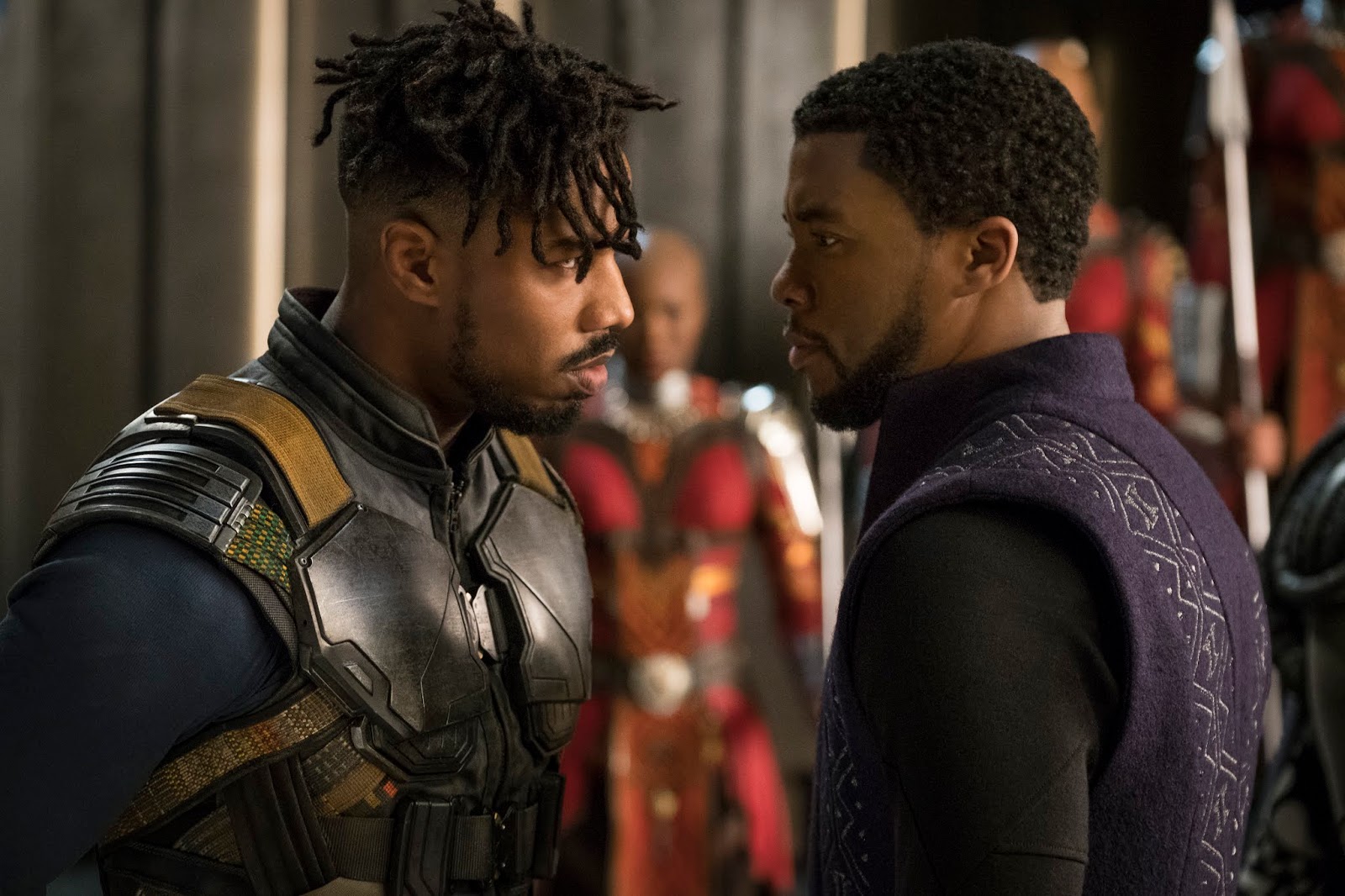
Colliding in "Black Panther" are Michael Jordan (left) and Chadwick Boseman
By Dominique Paul Noth

“Black Panther” was released to US theaters exactly a year ago and it is still hanging on (or picked up) at area theaters.  A film that cost $200 million made that back its opening weekend in February of 2018 and has gone on to gross $1.4 billion (!) worldwide.

It is the first Marvel Comics movie to be nominated among eight for the best picture Oscar, which is not tied to how well it was made but to how much media attention it has gotten. Yet it has been praised as an important step forward in African Futurism since it has elevated all its nations in the world’s awareness and borrowed from several of the continent’s cultures and languages.

It created a sort of master race of benevolence for Africa’s self-image (or to fix Trump’s image of the continent’s backwardness and poverty, a view many refuse to buy into). Its worldwide box office reminds the US that what is a minority culture view in this country sure ain’t the same internationally.

Some of the attention is a godsend for Oscar, which decided this year not to have a solo host, not after comedian Kevin Hart ran afoul of sexual behavior reports.  Among the rumors of replacing ideas was having the cast of the Marvel “Avengers” series play bigger roles – a fruitful tie-in for an enormous franchise including “Black Panther.”  Look for cast members Chadwick Boseman, Lupita Nyong'o and Danai Gurira to at least have roles as presenters.

To many in the cast, just being on the awards lists is a rare honor. The thought of it winning best picture I admit fills me with dread.

For the black community it invented an entirely different culture using the Marvel model. It employed thousands of roto, paint, matte and other specialists on several continents, involving several studios and shops.  It is a mammoth example of what the movie industry can muster in the era of cgi and digital effects.  It is both a sad and wondrous example of what Steven Spielberg launched more than a quarter century ago with “Jurassic Park,” the first blockbuster to elevate this technological computer world into studio dominance. An entire generation has been raised on this sort of film, making traditional cinematic storytelling look a bit old-fashioned.

If the Oscars are about honoring the brutal kinetic power that studios can bring to bear on the screen, this is probably the best example.  If the ability to look inside our behavior and values is what movies should value most, that is more of an artistic standard, which I prefer. “Black Panther,” despite all the hoopla, is not about that except in its side elements.

For many in the black community, though, it has had the positive impact of dam bursting.  All those years of Tarzan movies defaming the African culture, all those years of only stereotype roles for black actors – either super good like Poitier or relegated to the alleys -- have fallen away with “Black Panther,” or so the hope goes. Maybe finally, the lives of so-called ethnic minorities can drive the movie business as they rule the music and television business, as seems to have become partly true in the last few months.

One thing is sure. From an economic as well as a storytelling viewpoint, black artisans should never be ignored again. That would be quite an accomplishment on its own.  But let’s not pretend the movie is something it isn’t.

Special effects, flashy explosions, rapid battlefield cuts, magical spears, martial arts wizardry, mechanical rhinos (horses restructured on computers), smart talking women, elaborate manufactured ceremonies based on African cultures, costumes flowing on or off the bodies --  are all mashed together in a typical Marvel plot. The power of acting some have praised is really the power of personality, how capably under the makeup the actors are moving within these strictures.  

This is movie acting in the modern era but how much Michael Jordan’s hair-do and body scars from the makeup crew have to do with his impact as Killmonger – that’s hard to figure, even for the actor.  We do know that some strong actors, Forest Whitaker and Angela Bassett, barely survive their costumes, though the costumes may well be the movie’s most artistic element. 

It’s a thrill ride adding pride and proof of economic clout to black audiences.  But in many ways, the black culture has been painted over with a winning Marvel Comics formula. A year in, we should at least realize there is a limit to how much pleasure our society can take from that.

Other current film reviews:
Mary Poppins Returns

The Ballad of Buster Scruggs

Roma

Vice

The Favourite

The Wife and best actress Oscar race

Blackkklansman

Green Book

Bohemian Rhapsody


About the author: Noth has been  a professional journalist since the 1960s, first as national, international and local news copy editor at The Milwaukee Journal, then as an editor for its original Green Sheet, also  for almost two decades the paper’s film and drama critic. He became the newspaper’s senior feature editor. He was tapped by the publishers of the combining Milwaukee Journal Sentinel for special projects and as first online news producer before voluntarily departing in the mid-1990s to run online news seminars and write on public affairs and Internet and consumer news. From 2002 to 2013 he ran the Milwaukee Labor Press as editor. It served as the Midwest’s largest home-delivered labor newspaper, with archives at milwaukeelabor.org.  In that role he won top awards yearly until the paper stopped publishing in 2013. His investigative pieces and extensive commentaries are now published by several news outlets as well as his DomsDomain dual culture and politics outlets.  He also reviews theater for Urban Milwaukee.


Tuesday, February 12, 2019

CHAMPION PERFORMANCE LIFTS ‘BOHEMIAN RHAPSODY’

Rami Malek channeling Freddie Mercury in 'Bohemian Rhapsody'
By Dominique Paul Noth

To students of rock ‘n’ roll, the title “Bohemian Rhapsody” immediately signaled a story about the 1980s greatest crowd-rousing rockers Queen and the incredible vocal ability of lead singer Freddie Mercury.  To most moviegoers it probably sounded like a bio of Brahms.

But not anymore, now that “Bohemian Rhapsody” has climbed not only the heights of the movie box office but also the awards ladder. This is also a movie where you want to catch the credits.  The famous opening 20th Century Fox fanfare is played as if Queen had hijacked the studio orchestra and the closing credits give you the real Freddie Mercury in concert to compare how smartly the movie has matched the people and times.

It is also up for best movie in the Oscar race, a tribute to how professionally it has been handled and polished, even exaggerating the historical connection between that Freddie performance at the Live Aid concert in 1985 and his AIDS related death six years later.  But all movie bios of celebrities play with events and mainly “Bohemian Rhapsody” plays purposefully in emphasizing the private life and public persona of Freddie (birth name Farrokh Bulsara).

It carries viewers  from long-haired in-your-face mocking club strut  at  the start of his career to the flamboyant, mustached master of virile stage antics at mammoth auditoriums, even as his private life became more bisexual and dangerous.

Rami Malek gives the performance of the year, seamlessly adopting Freddie’s movements and excesses without condescension or comment, exploring his impulsive private demons and flights from responsibility. 

A certain zealous adulation is involved in any such biopic. Here it certainly paints Queen as the greatest rock band of all times.  Well, certainly they had the most fantastic lead singer and the movie will bring a needed re-evaluation of just how high in the annals of rock Queen should be placed.  Its anthems seeking crowd participation, its long lyrical phrasings have endured over time, but so has some pedestrian output as the band itself cheerfully admits and the movie even jokes about.

The movie can’t resist making a major romantic subplot about the wonderful girl that Mercury’s flings with men cost him, but there is truth within. The film’s Mary, played with vivid knowing looks by Lucy Boynton, was often called by Mercury his best friend and even wife. Her direct warmth is countered by Allen Leech’s portrayal of an attractive slimeball, Paul, the manager who helps lead Mercury into moral ruin (again a bit of playing with historical events).

The film has attractive expert cinematic elements under director Bryan Singer, famous for the X-men franchise but, more notoriously, for accusations of sexual misconduct that he vehemently denies.  Nevertheless, that offscreen controversy has influenced attitudes about the movie and its awards likelihood.

But the technical expertise deserves recognition, including fast and pertinent editing by John Ottman.  The makeup and casting physically duplicate the famous onstage and backstage teams of musicians and even more amazing is the camera magic that re-creates the enormous crowd and emotion at the Live Aid concert.

The sound effects team deserves every award in sight, matching Malek to outtakes and actual takes of Mercury performances, niftily interlocked with actual studio dialog.
 Malek has the square jaw and large eyes to convey the Freddie of legend, but it is his acting that makes the central driving story work.  His sync is masterful through false teeth that mimic the profound overbite that Freddie credited for his vocal technique and endurance (though I know many a music teacher who would say this was not the central factor given his smooth three-octave range). 

For degree of difficulty Malek wins the Oscar hands down.  But it will not be that simple, given how well Bradley Cooper directs himself in “A Star Is Born” and given that Christian Bale could share (but isn’t required to) co-credit with his Dick Cheney makeup artists should he win for “Vice.” Also in the race is a Wisconsin native for a film most people haven’t seen --Willem Dafoe as Vincent Van Gogh in “At Eternity’s Gate,” a film already on DVD release and at Amazon. 

But there is a strong dark horse in the race who was passed up last year for “Captain Fantastic” – Viggo Mortensen, delightfully a New York wise guy in “Green Book.”

Other current film reviews:
Mary Poppins Returns

The Ballad of Buster Scruggs

Roma

Vice

The Favourite

The Wife and Oscar’s best actress race

Blackkklansman

Green Book


About the author: Noth has been  a professional journalist since the 1960s, first as national, international and local news copy editor at The Milwaukee Journal, then as an editor for its original Green Sheet, also  for almost two decades the paper’s film and drama critic. He became the newspaper’s senior feature editor. He was tapped by the publishers of the combining Milwaukee Journal Sentinel for special projects and as first online news producer before voluntarily departing in the mid-1990s to run online news seminars and write on public affairs and Internet and consumer news. From 2002 to 2013 he ran the Milwaukee Labor Press as editor. It served as the Midwest’s largest home-delivered labor newspaper, with archives at milwaukeelabor.org.  In that role he won top awards yearly until the paper stopped publishing in 2013. His investigative pieces and extensive commentaries are now published by several news outlets as well as his DomsDomain dual culture and politics outlets.  He also reviews theater for Urban Milwaukee.